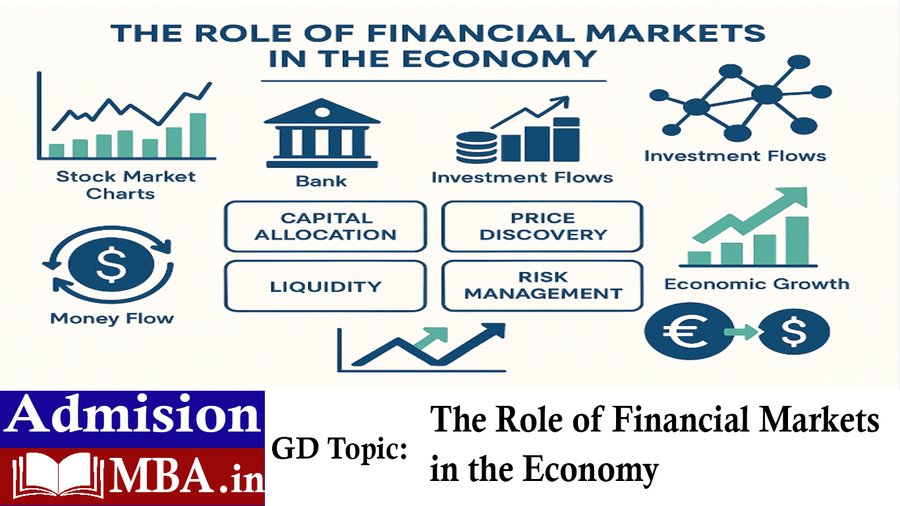
Introduction: Definition and Overview of Financial Markets
- Financial markets are platforms or systems where buyers and sellers trade financial instruments such as stocks, bonds, derivatives, currencies and commodities.
- They play a crucial role in channeling funds from savers to borrowers, facilitating capital formation and economic development.
- The efficiency and stability of financial markets are vital for the overall health of an economy.
Mobilization of Savings and Capital Formation
- Financial markets enable individuals, corporations and governments to convert savings into investments by providing liquidity and investment opportunities.
- They encourage savings by offering a variety of investment products with different risk-return profiles.
- Efficient mobilization of capital fuels business expansion, infrastructure development and innovation.
Efficient Allocation of Resources
- Financial markets allocate resources to their most productive uses by directing funds to enterprises and projects with the highest growth potential.
- Price discovery mechanisms in stock and bond markets help determine the value of assets based on demand and supply.
- This efficient allocation maximizes economic output and fosters sustainable growth.
Facilitating Economic Growth and Development
- By providing capital for investment, financial markets support industrialization, job creation and technological advancement.
- Well-functioning markets attract domestic and foreign investments, enhancing a country’s economic competitiveness.
- Emerging economies with developed financial markets typically experience faster economic growth.
Risk Management and Diversification
- Financial markets offer instruments such as derivatives that help individuals and firms hedge against risks like price fluctuations, interest rate changes and currency volatility.
- Investors can diversify their portfolios across various assets, sectors and geographies, reducing overall risk.
- Risk management enhances economic stability by mitigating financial shocks.
Liquidity Provision
- Markets provide liquidity, enabling investors to quickly buy or sell securities without causing significant price changes.
- Liquidity lowers the cost of capital, encourages investment and allows businesses to raise funds efficiently.
- Active secondary markets increase investor confidence and participation.
Price Discovery and Information Efficiency
- Financial markets act as information aggregators where prices reflect all available information about an asset’s value.
- Transparent price signals guide investment decisions, resource allocation and policy formulation.
- Efficient markets reduce information asymmetry and promote fairness.
Promoting Corporate Governance and Accountability
- Publicly traded companies are subject to regulatory requirements, financial disclosures and scrutiny from investors.
- Market discipline incentivizes firms to maintain transparency, operational efficiency and ethical practices.
- Good corporate governance enhances investor trust and market stability.
Supporting Monetary Policy Implementation
- Central banks use financial markets to implement monetary policy through open market operations, influencing liquidity and interest rates.
- Bond markets reflect market expectations of inflation, growth and policy shifts, guiding monetary authorities.
- Stable financial markets enable effective transmission of monetary policy to the real economy.
Encouraging Innovation and Entrepreneurship
- Venture capital and private equity markets finance startups and innovative projects that might not qualify for traditional bank loans.
- Financial markets provide an exit mechanism through IPOs and mergers, incentivizing entrepreneurship.
- Innovation drives productivity gains and economic diversification.
Challenges: Market Volatility and Speculation
- Financial markets can experience periods of excessive volatility due to speculation, herd behavior or external shocks.
- Such volatility can deter long-term investment and destabilize economies.
- Regulatory oversight is essential to curb manipulative practices and maintain orderly markets.
Systemic Risk and Financial Crises
- Interconnectedness of financial institutions and markets means failures can propagate rapidly, causing systemic crises.
- Examples include the 2008 global financial crisis triggered by collapse in mortgage-backed securities markets.
- Strong regulatory frameworks and risk management systems are needed to mitigate systemic risks.
Role in Promoting Financial Inclusion
- Well-developed financial markets broaden access to financial services for individuals and small businesses.
- Innovations like microfinance, mobile banking, and digital platforms extend reach to underserved populations.
- Financial inclusion supports poverty reduction and equitable economic development.
Impact on Income Distribution and Social Equity
- Access to financial markets can create wealth and employment opportunities, contributing to economic mobility.
- However, unequal access may exacerbate income inequality and social disparities.
- Policies to democratize market participation are important for inclusive growth.
Globalization and Integration of Financial Markets
- Cross-border capital flows and interconnected markets facilitate global investment and risk sharing.
- International financial markets enable countries to tap global savings and diversify funding sources.
- However, global integration also transmits economic shocks across borders, necessitating coordinated regulation.
Technological Advancements and Market Efficiency
- Technology has transformed financial markets through electronic trading, algorithmic trading and blockchain applications.
- Increased speed, transparency, and accessibility improve market efficiency but also introduce new risks such as cyber threats.
- Fintech innovations expand financial services and improve customer experiences.
Regulatory Role and Market Stability
- Regulators establish rules to protect investors, ensure transparency and maintain fair competition.
- Regulatory bodies like SEBI, SEC, and FCA oversee market operations and prevent fraud and manipulation.
- Balanced regulation fosters trust and sustainable market development.
Environmental, Social, and Governance (ESG) Investing
- Growing awareness of sustainability issues has led to the rise of ESG-focused investments.
- Financial markets increasingly incorporate ESG criteria, influencing corporate behavior towards responsible practices.
- This trend supports long-term economic and social well-being.
Education and Financial Literacy
- Effective functioning of financial markets depends on informed participation by investors.
- Financial literacy programs empower individuals to make sound investment decisions and understand risks.
- Educated investors contribute to market stability and efficient capital allocation.
Conclusion: Pillars of Economic Prosperity
- Financial markets are indispensable for economic growth, development and stability.
- They facilitate capital flow, risk management, innovation and efficient resource allocation.
- For MBA professionals, comprehending the role and dynamics of financial markets is essential to driving business success and contributing to national economic progress.